


2026 TPA Trend Report
Insights for healthcare consultants
Market Snapshot

of RFPs require dedicated staff
Dedicated service is now standard across the benefits landscape
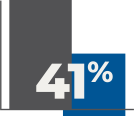
of employers are changing PBMs or running an RFP
Cost containment pressure is driving PBM change
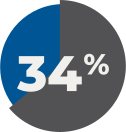
of covered workers qualify for a GLP-1 drug
More than 1 in 3 covered employees have a BMI that medically qualifies them

employers are investing in value-based network strategies
The network conversation has shifted to value
1.
Service Expectations Have Permanently Shifted
Why dedicated staffing is no longer a premium, it's the baseline
2.
Cost Containment Strategies That Actually Move the Needle
Restructuring to Total Cost of Care guarantees
3.
Wellness Programs: From Checkbox to Clinical Strategy
GLP-1s, specialized care management, and what members need now
4.
Network Strategy in a Multi-Option World
How smart network choices protect members and plans
Service Expectations Have Shifted
Dedicated service doesn't just check the box. It creates a member experience that reinforces the value of the benefit at every touchpoint.
Not long ago, dedicated account management and customer service were premium offerings reserved for the largest employer groups. That era is over. In 2026, more than 90% of benefits RFPs explicitly require dedicated staffing arrangements, regardless of group size.
For many clients, this shift represents a genuine opportunity to raise the floor on member experience. When members interact with their benefits administrator, a service model with named contacts, trained reps, and real escalation paths is something they notice and value.
What clients and plan administrators are asking for:
- A named, dedicated account manager with authority to resolve issues
- Dedicated customer service reps trained on the specific plan details
- A dedicated claims contact or team, not a general queue
- Clear escalation paths documented in writing
As a healthcare consultant, push your TPA partners on specifics. 'Dedicated' means different things to different administrators. Ask for staff-to-client ratios, turnover metrics, and escalation response time guarantees in writing, as part of the performance guarantee framework.
One additional nuance: some of this demand is consultant-driven rather than purely client-driven. As consultants increasingly build dedicated staffing requirements into standard RFP templates, it becomes a floor all vendors must meet, which means the differentiator has shifted from whether a TPA offers dedicated staffing to how well they actually deliver it.
What Success Looks Like
A plan with a truly dedicated service model doesn't just check the box, it creates a member experience that reinforces the value of the benefit at every touchpoint. When a member calls about a claim and reaches someone who knows their plan, their local network, and their history, that's not a small thing. It's a demonstration of administrative competence and member advocacy. The right TPA partner makes that possible, and makes it measurable through performance guarantees with real dollars at stake.
Cost Containment Strategies That Actually Move the Needle
The plans winning on cost aren't spending less — they're spending smarter, with better data and tighter accountability.
Cost containment has always been a priority for self-funded plans, but the bar for what counts as a credible program has risen significantly. Plan sponsors are no longer satisfied with vague savings claims. They want specifics, and the TPAs that can deliver them are pulling ahead.
The PEPM Pricing Shift
One of the clearest trends in 2026 is the growing preference for payment integrity programs priced on a per-employee-per-month (PEPM) basis, rather than a percentage of savings. This is especially prominent for out-of-network cost management.
PEPM pricing creates more predictable cost structures and better-aligned incentives for everyone at the table. For plan sponsors managing long-term financial performance, that predictability has real value. Ask whether your TPA's payment integrity vendors covering coordination of benefits, claims editing, subrogation, fraud/waste/abuse, and clinical reviews can structure fees on a PEPM basis, and whether caps are available on savings-based programs.
The PBM Relationship Is Back on the Table
Pharmacy is the fastest-growing line item in most benefit plans, and in 2026, plan sponsors are no longer treating the PBM contract as untouchable. There's been an Rx cost growth of 9.4% per employee. More than 40% of employers are either switching PBMs or running a formal RFP, reflecting growing frustration with rebate-based revenue models, limited pricing transparency, and misaligned incentives around specialty drug utilization. For consultants, this is an opening. Pressure-test your clients' current PBM arrangement on the specifics: pass-through pricing, rebate retention, formulary control, and specialty drug management. The PBMs that can answer those questions cleanly are worth keeping. The ones that can't are increasingly being replaced — and the market has more viable alternatives than it did even two years ago.
Total Cost of Care Guarantees
A growing segment of sophisticated plan sponsors are requesting Total Cost of Care guarantees from their TPA — a contractual commitment to overall trend performance, not just claims processing accuracy. For plans with multi-year planning horizons, this model is a natural fit: it turns a vendor relationship into a performance partnership with real accountability on both sides. Even for plans not yet ready for a full Total Cost of Care guarantee, incorporating specific sub-guarantees, including network performance, medical management ROI thresholds and payment integrity savings minimums, builds a track record and creates the data foundation for stronger guarantees at future renewals.
What Success Looks Like
A client with a well-structured cost containment strategy isn't just cutting spend, it's demonstrating financial discipline to the members and leadership who depend on the plan's long-term health. The best TPA partnerships translate cost containment from a line item into a documented, measurable commitment: here's what we saved, here's how we did it, and here's what we're accountable for going forward. That's the conversation worth having at every renewal.
Wellness Programs: From Checkbox to Clinical Strategy
Members who get the right health support earlier cost less and live better. That's a win for everyone at the table.
Wellness has been a fixture of benefits RFPs for years, but 2026 marks a turning point in what plan sponsors actually expect. The shift away from biometric screenings and basic HRAs toward clinically grounded programming is an opportunity — particularly for plans whose population health demographics make a strong case for targeted wellness investment.
Specialized Condition Management
Employers and plan sponsors are now requesting programs specifically designed for metabolic syndrome, cardiovascular disease, COPD, cancer support, and menopause — conditions that reflect the actual health burden of many member populations, particularly those in physically demanding trades or with older average age demographics. These aren't just cost mitigation tools. For members managing serious conditions, they are a meaningful expression of what the plan is for. The most effective programs are integrated with medical management — not bolted on as point solutions. When wellness coaching, care management, and claims data are connected, plans can identify members at risk earlier, intervene more effectively, and demonstrate ROI that justifies continued investment.
Getting Ahead of GLP-1 Costs
GLP-1 medications and emerging gene therapies are appearing regularly in 2026 benefits RFPs, and plans that develop clear policies now will be far better positioned than those reacting to coverage demands later. A well-constructed GLP-1 policy — with defined clinical criteria, prior authorization protocols, and long-term cost projections — protects the plan while ensuring members with genuine clinical need can access medications that work.
What to Look for in a Wellness Vendor Ecosystem
- Biometrics, HRAs, personal health records, and member incentive programs
- Condition-specific programs: metabolic syndrome, cardiovascular, musculoskeletal
- Integration with medical management and care coordination functions
- A documented GLP-1 coverage policy with prior authorization criteria
What Success Looks Like
A wellness strategy that actually works starts with understanding who the members are — their jobs, their health risks, their age distribution — and building programs that meet them there. When a benefits plan catches a member's unmanaged diabetes or cardiovascular risk before it becomes a catastrophic claim, that's a financial win for the plan and a life-changing outcome for the member. A TPA with the right clinical partnerships and integrated data infrastructure makes that kind of proactive, personalized wellness possible at scale.
Network Strategy in a Multi-Option World
More network choices means more opportunity to build a plan that genuinely fits your members, if you know how to use them.
The expansion of network options in the self-funded market is, at its core, good news for plan sponsors. For the first time, a plan serving members across multiple geographies or industries has real flexibility to configure a network that actually reflects where their members live, work, and seek care, rather than accepting a national contract designed for someone else.
Multiple Networks Are Now the Expectation
Commercial TPAs are increasingly expected to offer multiple network options (commonly six to eight distinct choices) giving plan sponsors the ability to select configurations appropriate for their member geography and utilization patterns. This includes tiered network designs, narrow networks for specific high-cost service lines, and regional options that deliver stronger performance in specific markets. For plans with geographically diverse populations, the ability to tier the network — routing members toward high-quality, cost-efficient providers for high-cost procedures — can deliver meaningful savings while improving outcomes. The key is having a TPA partner with the flexibility and infrastructure to administer that complexity.
Direct Contracting and Centers of Excellence
Larger plans are increasingly exploring direct contracting arrangements — negotiating directly with health systems for defined service lines, particularly high-cost surgical procedures, cancer treatment, and complex care. Centers of Excellence programs are a practical entry point: they route specific high-cost procedures to high-quality, cost-efficient facilities, and the savings and outcome data that result build the case for deeper direct contracting over time.
Reference-Based Pricing: A Tool, Not a Solution
Reference-based pricing has delivered real savings for some plans — and real friction for others. The difference usually comes down to member advocacy and balance billing support infrastructure. Members expect their plan to have their back, and an RBP strategy that saves money but leaves members navigating billing disputes without support will undermine trust in the plan. Used well, with robust advocacy behind it, RBP is a legitimate tool. Used carelessly, it becomes a member relations problem.
What Success Looks Like
Network strategy, done well, is one of the most powerful tools a plan has. A plan that routes its highest-cost procedures to Centers of Excellence, uses tiered network design to reward smart provider choices, and gives members transparency tools that actually help them decide — that's a plan that delivers value members can see and feel. A TPA that brings network flexibility, direct contracting experience, and member advocacy infrastructure to the table isn't just administering a plan. They're building one worth administering.
Final Thought
The Plans That Win Are Already Making These Moves
The trends in this report aren't headwinds, they're a map. The cost environment is more complex than it was five years ago, member expectations are higher, and the marketplace has more options than ever. For healthcare consultants advising clients, that's an environment where expertise and preparation create real, measurable advantages. The plans that are coming out ahead share a few things in common: they've built partnerships with TPAs who bring genuine accountability structures, not just standard service agreements. They've developed proactive policies on the issues before those issues became urgent. And they've treated their benefits consultant as a strategic partner, not just a procurement resource.
That's the conversation we think is worth having. Not just what the market is doing, but what your specific members need, what your plan can sustain, and what a TPA partnership built around those realities actually looks like in practice.